
What's a good shooting percentage?
By Matthew Parrott, who makes Tally Hoops ·
It depends on the shot and the level. Here are the latest league-wide free throw, three-point and field goal percentages from the NBA, WNBA and NCAA Division I, what little there is for high school, and how to think about your own numbers in practice.
Free to download · iPhone and Apple Watch
The benchmarks
Each pro and college number below is a whole league's makes divided by its attempts for the most recent complete season, so it's the average shot, not the average player. Sources and seasons are listed at the end of the page.
| Level | Season | Free throws | Threes | All field goals |
|---|---|---|---|---|
| NBA | 2025-26 regular season | 78.3% | 36.0% | 47.1% |
| WNBA | 2026 regular season | 78.6% | 34.0% | 45.2% |
| NCAA Division I men | 2025-26 | 72.4% | 34.1% | 45.2% |
| NCAA Division I women | 2025-26 | 71.3% | 31.0% | 40.8% |
| High school | No national data | 55–60% (a 2012 estimate) | – | – |
The NCAA rows add up every Division I team's makes and attempts from Sports-Reference's season totals (365 men's teams, 363 women's), so they're computed the same way as the pro leagues' averages.
What counts as good, shot by shot
Free throws
Professionals make a little under 80% from the line: 78.3% in the NBA's 2025-26 regular season and 78.6% in the WNBA's 2026 season. The NBA's number barely moves; it was between 78.0% and 78.4% in each of the last four seasons. Among the 152 NBA players who took at least 125 free throws in 2025-26, the middle player made 79.8%, and only five made 90% or better. So 80% puts you level with a typical NBA regular, and 90% is rare even there.
Division I college teams made about 72% (men) and 71% (women) in 2025-26. High school data is thin: there's no national count. The figure you'll see quoted most, 55 to 60 percent, comes from a 2012 post by Noah Basketball, a company that makes a shooting-analysis system, which offered it as its belief while saying it didn't have statistics for high schools across the country. Treat it as a rough guide, not a measurement.
Three-pointers
The NBA made 36.0% of its threes in 2025-26, and has been between 36.0% and 36.6% in each of the last four seasons. The WNBA made 34.0% in 2026, Division I men about 34% and Division I women about 31% in 2025-26.
Among the 187 NBA players who took at least 200 threes in 2025-26, the middle player made 36.7%, and 29 made 40% or better, so 40% on real volume is rare even in the NBA. It also helps to remember what a three is worth: 33.3% from three scores as many points per shot as 50% on twos.
All field goals
Field goal percentage counts every shot except free throws, so it blends layups with threes: 47.1% in the NBA, 45.2% in the WNBA, and about 45% and 41% for Division I men and women. It says as much about which shots a player takes as how well they make them, so for your own practice it's more useful to track each kind of shot on its own.
What's a good percentage in practice?
Practice and games aren't the same shot. In a workout nobody contests you, you pick the spot, you're often fresh, and a miss costs nothing, so practice numbers usually run higher than game numbers. Treat the game benchmarks above as a floor for practice rather than a target: if you make 70% of your free throws in an empty gym, that's not the same as making 70% in the fourth quarter.
The most useful benchmark is your own. Shoot the same kind of session each time, count every attempt, and compare this month with last. If you want a yardstick inside Tally Hoops, its drills are graded on accuracy, and these are the app's own thresholds, not league data:
| Drill shot type | Bronze | Silver | Gold |
|---|---|---|---|
| Free Throws | 60% | 75% | 90% |
| 3 Pointers | 30% | 40% | 50% |
| Freestyle (any shot) | 40% | 55% | 70% |
To make your practice number mean more, make some of it harder. Shoot when you're tired, because you'll be tired in games too; Tally Hoops' Fatigue Cliff shows the heart rate where your make rate falls off. Shoot at game speed. And try a rule that makes misses cost something, like Pressure 5, where you have to make five in a row to clear a rung. More on the drills.
How to measure yours
A percentage is only as good as the count behind it. Count every attempt as it happens, keep free throws, threes and everything else in separate sessions, and give it enough shots: for a 35% three-point shooter, a single 50-shot session can land anywhere from 21.5% to 48.5% by chance alone.
- Shooting percentage calculator: your percentage from makes and attempts, and how far luck could move it.
- How to track your shooting percentage: the formula, the rules for an honest count, and reading the trend.
- Free throw tracker: logging every free throw from your wrist, with drills and goals.
- Three-point tracker: why threes need so many shots before the number settles.
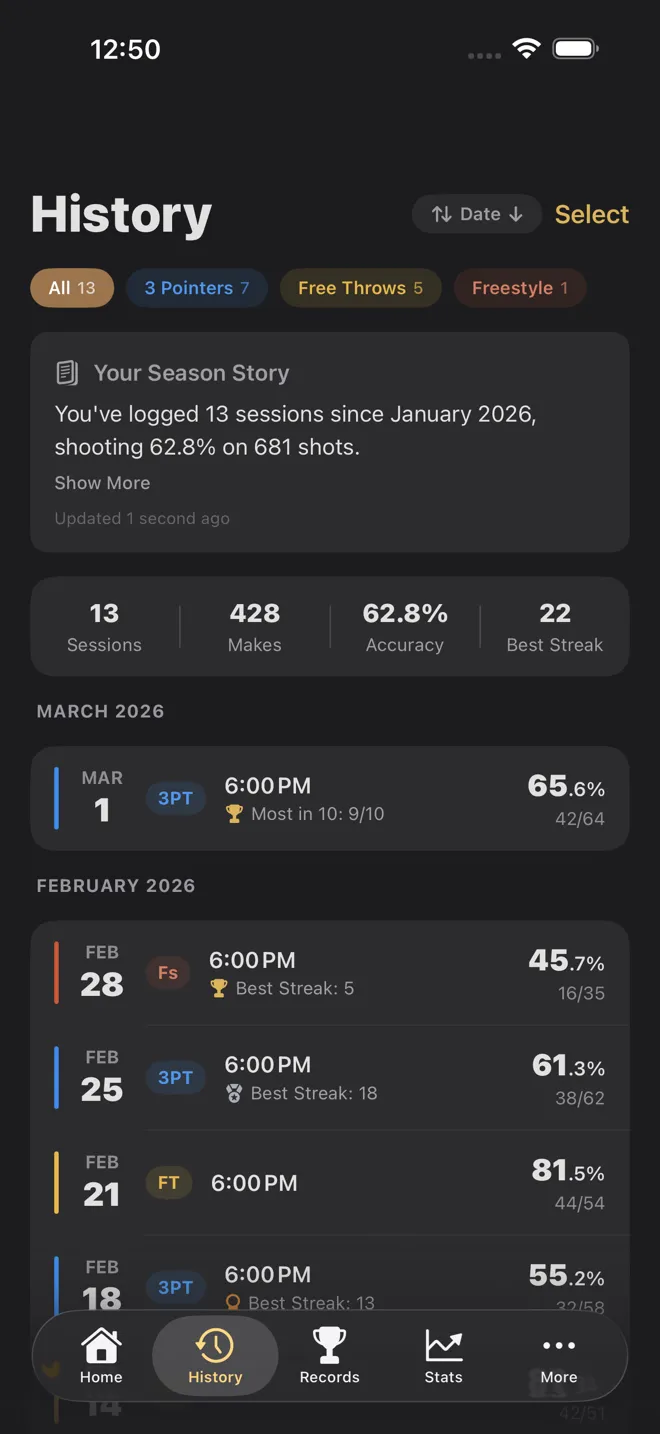
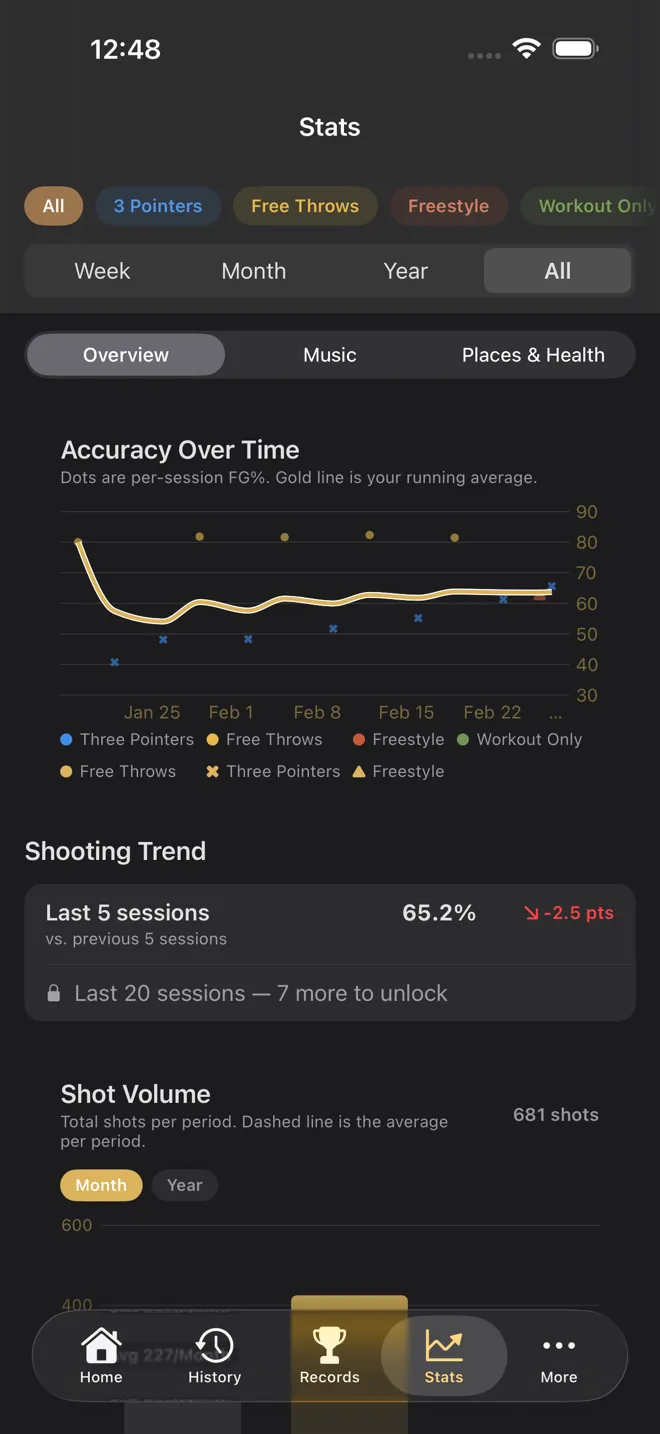
Tally Hoops keeps Three Pointers, Free Throws and Freestyle sessions apart, so your history and Stats can be filtered to one shot at a time, and its Shooting Trend compares your last 5 and last 20 sessions with the ones before. It's free to download and log with.
Sources
- NBA league averages, 2022-23 to 2025-26 regular seasons: Basketball-Reference, NBA League Averages.
- NBA player shooting, 2025-26 regular season: Basketball-Reference, 2025-26 NBA Player Stats: Totals.
- WNBA league averages, 2026 regular season: Basketball-Reference, 2026 WNBA Season Summary.
- NCAA Division I men, 2025-26: Sports-Reference, 2025-26 Men's College Basketball School Stats.
- NCAA Division I women, 2025-26: Sports-Reference, 2025-26 Women's College Basketball School Stats.
- High school estimate, 2012: Noah Basketball, Basketball Shooting Percentages and Statistics.
All read on October 14, 2026.
Checked against Tally Hoops 3.11 on October 14, 2026.
Questions
What is a good free throw percentage?
League-wide, NBA players made 78.3% of their free throws in the 2025-26 regular season and WNBA players made 78.6% in 2026, while NCAA Division I teams made about 72% (men) and 71% (women) in 2025-26. Among NBA players with at least 125 attempts that season, the middle player made 79.8%, and only five made 90% or better.
What is a good three-point percentage?
NBA players made 36.0% of their threes in the 2025-26 regular season, WNBA players 34.0% in 2026, and NCAA Division I teams about 34% (men) and 31% (women) in 2025-26. Making 40% on real volume is elite: 29 of the 187 NBA players who took at least 200 threes in 2025-26 did it.
What is a good field goal percentage?
League-wide field goal percentage was 47.1% in the NBA in 2025-26, 45.2% in the WNBA in 2026, and about 45% for NCAA Division I men and 41% for women in 2025-26. Field goal percentage mixes layups and threes, so a player who takes a lot of threes will usually have a lower one than a player who scores near the rim.
What's a good free throw percentage in high school?
There's no reliable national data for high school shooting. The most-cited estimate, a 2012 post from the shooting-training company Noah Basketball, put high school free throw shooting at 55 to 60 percent, while noting it didn't have statistics for high schools across the country.
Should my practice percentage be higher than my game percentage?
Usually, yes. Practice shots tend to be uncontested, from spots you chose, without game pressure and often on fresh legs, so most players shoot better in workouts than in games. Compare practice with practice, and make some of it harder: shoot tired, at game speed, or under a make-in-a-row rule.